

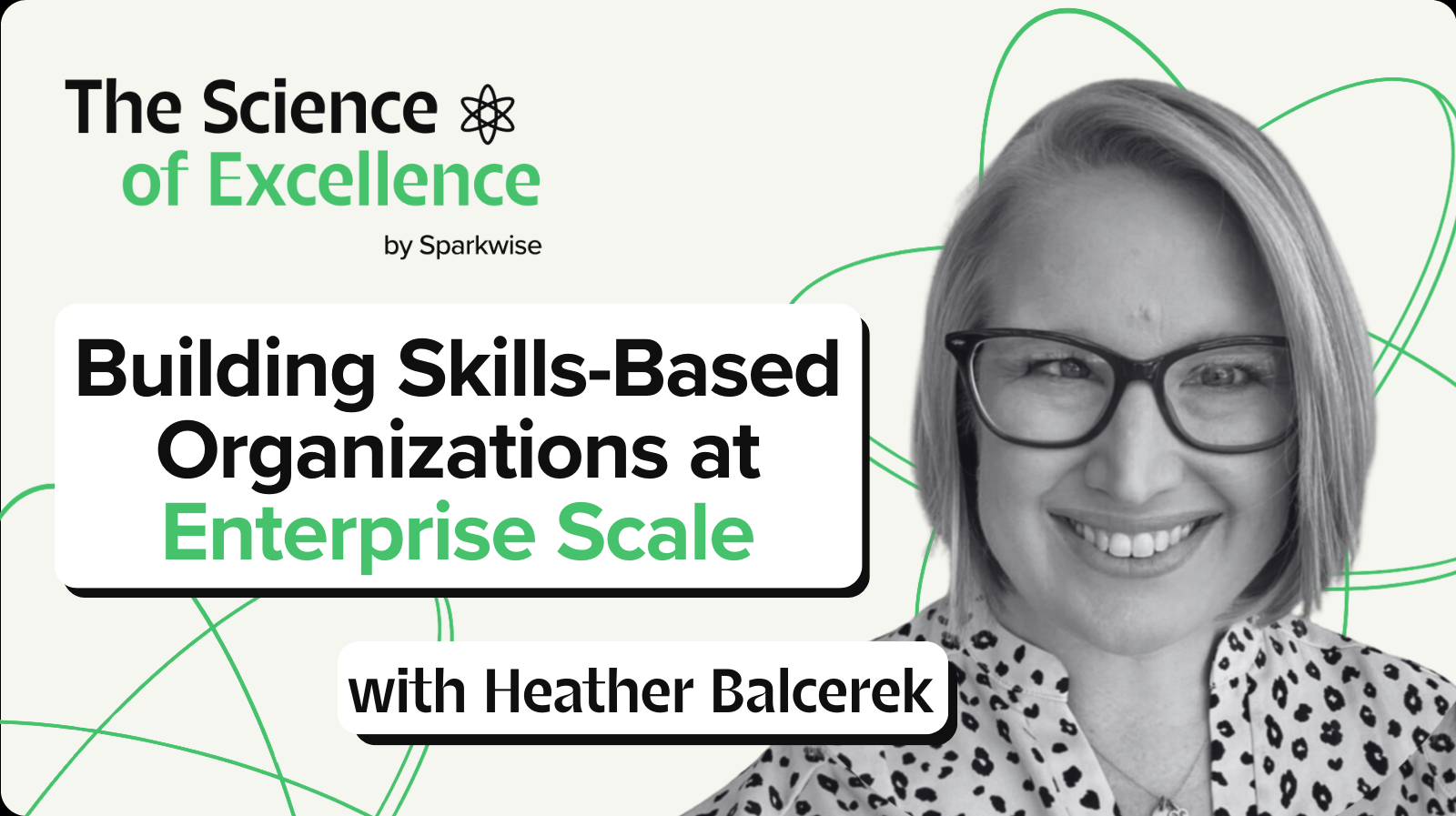

In this episode of The Science of Excellence, I sat down with Heather Balcerek, Sr. Manager of Corporate L&D at Maximus, a government contractor with over 250 contracts across federal and state health and human services.
We talked about why their contracts operating like individual companies forced Maximus towards a skills-based model, how they justify ROI beyond pure dollars, and why adoption is harder than implementation. Heather shared insights on meeting learners where they are across different levels and why helping people see themselves as more than a title matters.
These 5 insights stood out:
- Use Skills as the Common Language Across Silos
- Calculate ROI Beyond Just Dollars
- Design Learning for Each Level's Reality
- Solve for Adoption, Not Just Implementation
- Help People See Beyond Their Title
1. Use Skills as the Common Language Across Silos
In Heather's Words: "We have over 250 different contracts, which you can imagine is like almost 250 individual companies. What we're really trying to solve for is the inconsistency. The different expectations, the different definitions of things. Like what does good look like? Skills is the thing that connects all of our contracts together. There are similar skills across these 250 plus contracts. Whether you're supporting Medicare, Medicaid, or a local state function, those are transferable skills where somebody on one contract can easily upskill to learn a new system."
When you have that many contracts operating independently, each develops its own standards, definition of good and approach to development in isolated pockets.
The problem with silos is you lose the advantage of accumulated experience. Someone with 10 years on a state contract can't easily move to federal work even though their skills directly apply. Skills create a common language that lets people transfer between contracts and brings consistency to what was fragmented.
2. Calculate ROI Beyond Just Dollars
In Heather's Words: "If you think about it in just dollars and cents, it's not gonna make a lot of sense. One contract has this particular set of skills and maybe that contract is ending. If we don't take those people and reskill them to a different contract that maybe is coming in, we have to let those people go. That new contract comes in a month later. We rehire half those people. We have now just spent that money to let these people go, ship all their stuff back, then we hire them again and ship all their stuff back to them. But think about it from the employee perspective. I have that opportunity to stay with a company to continue my career. I have some stability here."
Pure dollar ROI misses the point because skills-based transformation is expensive and the returns show up in multiple places simultaneously.
Start with the obvious churn cost: letting people go when a contract ends, then rehiring them a month later when a new one starts wastes money on severance and equipment logistics. But employee experience matters too. People who can stay with the company through contract transitions have stability and feel valued. Then there's readiness, where knowing what skills you have internally means you don't waste time recruiting when a new contract comes in because you can match existing people to needs. And finally customer experience, where clients get skilled people faster instead of brand new hires learning from scratch. The ROI shows up in retention, engagement, speed, and quality rather than just cost savings.
3. Design Learning for Each Level's Reality
In Heather's Words: "It's not one solution works for everybody. If you think about the frontline learner, the person that struggles to get off the phone, they don't have the time. We're looking at embedding practice into what they do already. We're looking at micro learnings and helping their managers learn how to do something, take it back to their teams, and giving managers the tools to do that. When we look at supervisors and mid-level managers, it's giving them quick hit practice. For executives, we've taken an approach doing cohort based things that are in person and more intensive for a couple of days. If the people can't come to you, you go to the people."
People want to learn and want to develop, but they don't have time. It's the reality of frontline work, not laziness.
Frontline workers can't leave the phones, so Heather embeds learning into their work and trains managers to cascade skills to their teams. Supervisors and mid-level managers get quick-hit practices they can implement immediately plus tools to teach their teams. Executives can't sit for eight hours, so Heather runs intensive multi-day cohorts with breathing room between sessions. Unfortunately, some contracts don't allow overhead for training hours.
The solution becomes trial and error by contract because what works at one site might not work remotely. Her mentality: if people can't come to you, you go to them.
4. Solve for Adoption, Not Just Implementation
In Heather's Words: "The most difficult part is adoption, getting people to use the tools that have been put in place. I will admit going into that system is not something I think about on a daily basis. And this is what I do. I should live and breathe it. But getting people to get in, assess themselves, getting managers to get in to assess themselves, and getting people to really focus on their development and what ways they can do that with where they are, is the most difficult part."
Implementation is the easy part: you buy software, configure job profiles, train people on the system. Adoption is where the real battle begins.
Getting people to log in, assess their skills, and build development plans requires habit change that doesn't come naturally. The system can recommend next roles and suggest courses to close skill gaps, but only if people engage with it consistently. Maximus is early in the journey and still figuring out how to drive usage beyond the initial training. The technical infrastructure works fine. The behavior change lags behind, which is normal because most skills-based transformations underestimate the adoption challenge and overinvest in implementation.
5. Help People See Beyond Their Title
In Heather's Words: "Being able to say, I'm not just a CSR, I'm not just somebody that answers the phone, and helping people really figure out the pieces and the skills that they bring to the table, and how can we upskill them and utilize those in so many different ways. I met a lady who owned her own business, she's done so many things that speak volumes, like she could do so much. I'm like, let's fix it. Let's figure this out. Let's look at these skills that you have and let's work that so that you can be seen. They can see themselves as more than just a title, just a job title."
Job titles can box people in, leading to limiting beliefs that stand in the way of further development.
Heather mentors someone who owned a business before joining Maximus but got stuck answering phones because her resume didn't surface those entrepreneurial skills. When you help people articulate what they actually bring, they can move into roles that use more of their capability. The practical benefit shows up in contract transitions. Instead of scrambling to recruit when new work comes in, Maximus looks internally at who has adjacent skills and upskills them for the gap. The promise of skills-based transformation is people becoming more than their title. The work is helping them see and articulate capabilities they already have.
Until next time,
Vince

.png)
.png)
.png)

.png)
.png)
.png)

.png)
.png)
.png)


.png)


.png)