

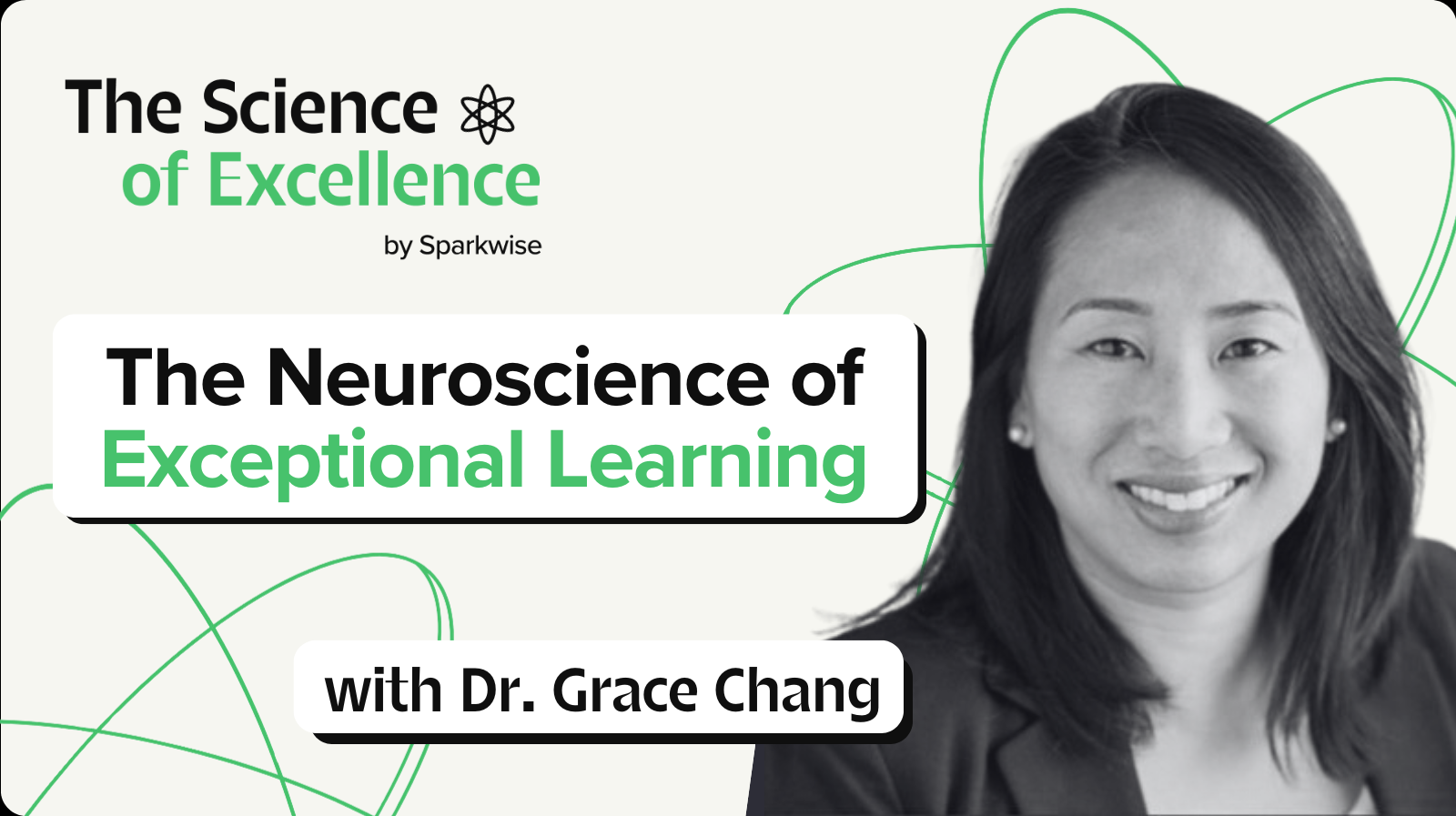

In this episode of The Science of Excellence, I sat down with Dr. Grace Chang at EY, who brings a neuroscience and behavioral science background to learning design. She's spent years translating brain research into practical principles that L&D teams can use to create learning that actually sticks.
We talked about what separates exceptional learning from ordinary training, the gap between knowing learning science and actually designing with it, and why social learning activates reward systems in the brain. Grace shared insights on what's happening at the neural level during learning and why most corporate training misses the mark.
These 5 insights stood out from our conversation:
- Create Psychological Safety Before Anything Else
- Design for Active Processing, Not Passive Consumption
- Close the Gap Between Knowing Science and Designing With It
- Leverage Social Learning to Activate Reward Systems
- Pause Regularly to Question What You're Building
1. Create Psychological Safety Before Anything Else
In Grace's Words: "Our brains are wired for social connection, but we avoid risk when we feel threatened. If learners don't feel safe, if they feel that they're gonna be judged for their responses or if they make a mistake or they'll look silly or stupid, they'll hold back. Exceptional learning environments make it okay to take risks and share ideas. If you start out from the beginning framing it as 'we're gonna make mistakes, this is an opportunity to learn,' really making it a safe environment without judgment—that opens the door for deeper engagement and learning."
Psychological safety isn't a nice-to-have, it’s the foundation. When people feel worried about looking stupid or being judged, their brains shift resources toward managing that threat rather than learning.
This shows up everywhere. In group problem-solving sessions where people stay quiet rather than risk a wrong answer. In training where learners nod along but don't ask clarifying questions. The fix is explicit framing at the start: mistakes are expected, questions are welcome, this is a space to learn not to perform.
2. Design for Active Processing, Not Passive Consumption
In Grace's Words: "When we actively process information—by elaborating, thinking about the meaning, repeating it to ourselves, or connecting it with what we already know—we're engaging our working memory, which is our prefrontal cortex's mental workspace. This active processing creates conditions that make encoding possible. And encoding is the first big step towards developing long-lasting learning. The hippocampus acts like a binding hub, taking information from different senses and binding it together into a cohesive short-term memory trace."
Learning requires effort. The brain needs to actively process information instead of just receiving it. This means elaborating on concepts, connecting new information to existing knowledge, and manipulating ideas in working memory.
Most corporate learning is designed for the opposite. We try to make things seamless, frictionless, and easy to consume. But that's not how the brain learns. Real learning is difficult. It requires attention and active engagement. Long slide decks with minimal interaction don't cut it. You need moments where learners have to think, connect, and apply.
3. Close the Gap Between Knowing Science and Designing With It
In Grace's Words: "The biggest gap is that even when organizations or L&D leaders know the learning science, they don't always design with that learning science in mind. We know that learning sticks best when it's spaced out over time—the spacing effect. But what organizations often do is default to one-and-done events. They expect a single workshop or webinar to make a drastic change. Science tells us learning is a process, not a singular event, but we're treating it as if everything can be learned in a big event."
Knowing and doing are different things. L&D teams often know the science—spacing effects, retrieval practice, active learning—but design one-and-done workshops anyway because of time pressure, stakeholder requests, or tradition.
The gap exists for real reasons. Stakeholders want immediate results. Subject matter experts want everything covered now so people can start doing things differently immediately. But cramming doesn't work. The solution is being clear about what compromises are acceptable and which ones will undermine learning entirely.
4. Leverage Social Learning to Activate Reward Systems
In Grace's Words: "We are inherently social creatures. Our survival historically was dependent on social connections for resources, protection, and safety. That's why our brains are wired to be highly sensitive to social cues, inclusion, recognition, and belonging. When we feel recognized and included, our brain's reward system becomes more active. The ventral tegmental area releases more dopamine to the nucleus accumbens, and it creates pleasure, boosts motivation, reinforces behaviors. Social connection feels rewarding like food or other basic necessities would be."
Social learning triggers different brain chemistry. When we interact with other humans, our brains release more dopamine than when we interact with AI. That dopamine boost enhances focus and motivation.
This explains why information from a trusted colleague sticks differently than information from a document. The social element adds emotional weight and activates reward circuits. When you design learning experiences that are social—cohort-based programs, peer learning, collaborative problem-solving—you're tapping into something fundamental to how our brains work.
5. Pause Regularly to Question What You're Building
In Grace's Words: "I think [my one piece of advice to L&D] would be pausing regularly when you're doing things and questioning. When we're under time and budget pressure and we've got this stakeholder and that stakeholder, we've got so much stuff going on, we're trying to check all the boxes—that's when we get into following certain traditions, doing things a certain way that may not serve the purpose. Really figure out what is it that we're trying to get people to learn. What do they need to be able to do? Work backwards from there and then regularly check in with ourselves: have we strayed too far from that?"
The hardest thing in a busy environment is to pause. But without pausing, you drift. Stakeholder requests pile up, compromises accumulate, and suddenly you're building something that doesn't serve the actual learning goal.
First you need to identify what learners need to be able to do, then regularly check whether what you're building serves that goal. When stakeholders request specific formats or delivery methods, pause and ask if those serve the learning outcome. Some compromises are fine, while others undermine everything.
Until next time,
Vince

.png)
.png)
.png)

.png)
.png)
.png)

.png)
.png)
.png)


.png)


.png)