

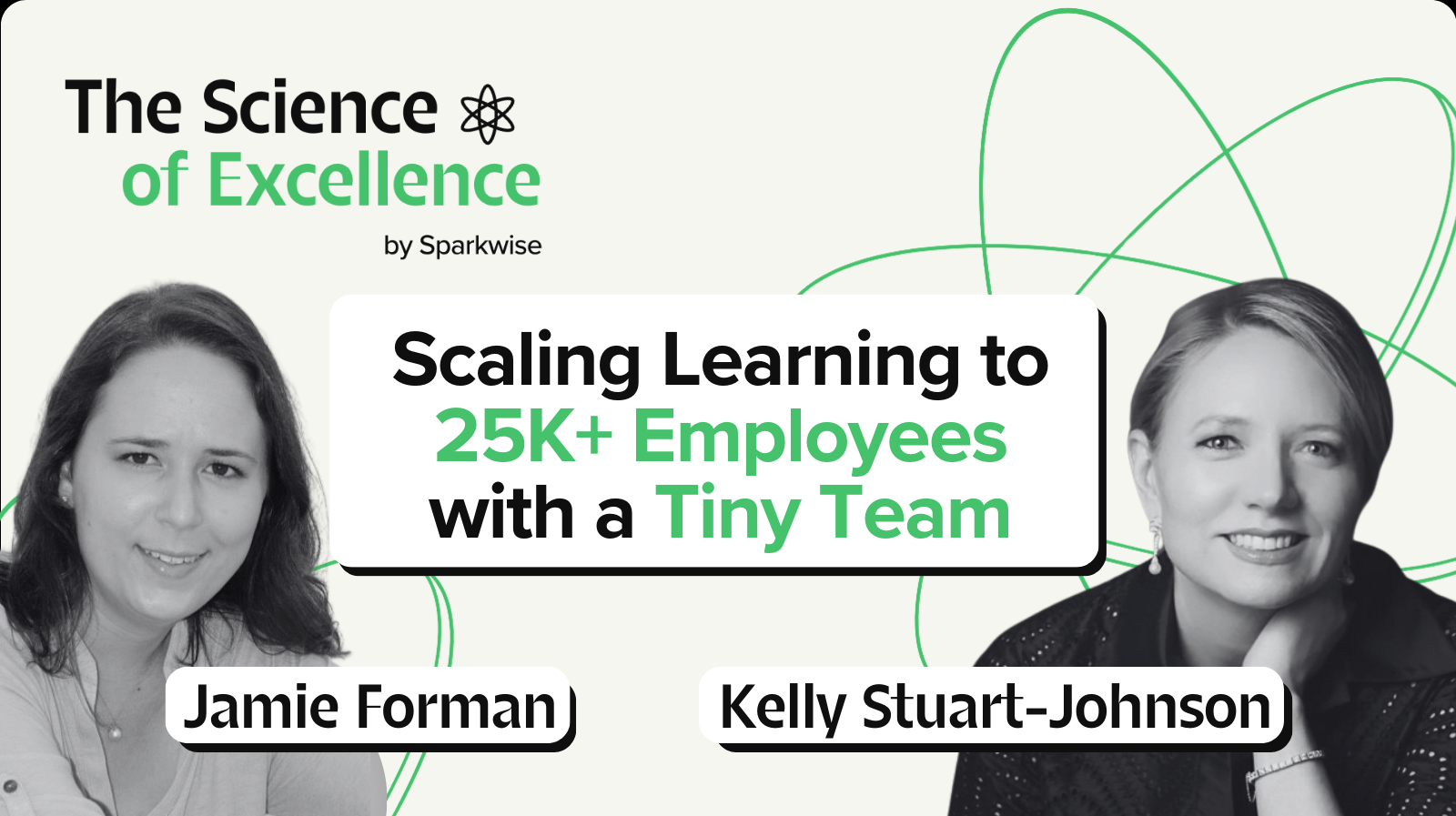

In this episode of The Science of Excellence, I sat down with Kelly Stuart-Johnson and Jamie Forman from global learning and development at VML, one of the world's largest creative agencies. Kelly and her team of five support 26,000 employees, delivering outsized impact through creative approaches to learning.
We talked about how they moved VML from 9% to number one in adopting WPP Open, their network's proprietary AI platform, across all agencies. Kelly and Jamie shared why they listen for behavior change instead of accepting proposed solutions, how they build simulated environments that drove 8,000 practice sessions, and why being surprised by your data matters.
These 5 insights stood out from our conversation:
- Build a Team of Owners to Run Like a Bigger, More Agile L&D Team
- Find Clever, Low-Effort Ways to Measure Behavior
- Listen for the Desired Change, Not the Proposed Solution
- Be Hyper Respectful of People's Time
- Be Surprised by Your Data
1. Build a Team of Owners to Run Like a Bigger, More Agile L&D Team
In Kelly's Words: "It sounds counterintuitive, but doing it internally with AI allows greater speed, flexibility, creativity and cost control. Not for content creation, but for coming up with singular novel solutions that I would've paid millions to a vendor for, then had many iterations after. It was the week before Christmas. We needed to do it ourselves, so we did. AI helped us learn to code in JavaScript."
Most L&D teams outsource because they lack technical skills. VML builds in-house, using AI as their teacher.
For WPP Open adoption, Jamie built simulated environments in Articulate Storyline, using AI to learn JavaScript and create step-by-step walkthroughs with tooltips that looked exactly like the real platform so people could practice safely. Building in-house gave them speed, the flexibility to iterate quickly, and cost control. AI doesn't write their content, but it teaches them new skills and helps them build solutions that would have cost millions from vendors.
This approach requires hiring people with an ownership mindset who come from diverse backgrounds. Their team includes a former sign language interpreter, two former middle school teachers, a former bartender, and two people from retail. Generalists who've done many jobs understand how to solve problems creatively with limited resources.
2. Find Clever, Low-Effort Ways to Measure Behavior
In Jamie's Words: "Traditionally learning measures attendance, completion metrics, or ratings. Our shift has been: how do we measure behavior change? What does that look like and how can we build measurement into the program itself so it doesn't feel like something extra, but is incorporated into learning? The 'go to workspace' button—nobody knew we were tracking clicks. We were just providing a way to practice for real. On the backend, we're counting how many said yes and went to workspace."
Attendance doesn't tell you if behavior changed, nor do satisfaction scores. VML measures actual behavior and hides the measurement inside the experience. This isn't always easy, but with active problem solving they've found clever solutions.
After each micro-method on WPP Open, they added a button to the real platform where clicking wasn't required, but 8,000 times people chose to practice immediately, measuring intent to apply. In their Hi series for difficult conversations, AI simulations provided rubrics measuring competence so that from first to third simulation people improved measurably, with the practice itself serving as the assessment.
Start by identifying what behavior you want to change, ask if you can measure it, then build measurement into the experience as an authentic task rather than extra homework. VML became number one in their network for platform usage because they measured and drove the behavior that mattered.
3. Listen for the Desired Change, Not the Proposed Solution
In Kelly and Jamie's Words: "People would come saying 'we want a series of hour-long workshops' or 'we want an eight-hour program.' Rather than listening for the solution being proposed, we listen for the behavior they're trying to change. Then go back and say: we understand what you're trying to change. Here may be a way to do it that you didn't think about, that will have larger impact and provide more value."
Stakeholders ask for workshops. They specify formats, durations, delivery methods. They fall in love with solutions they've seen before.
Instead of simply taking the order, you need to translate beneath the request to find what behavior actually needs to change. When VML merged and needed to educate 26,000 people on new capabilities, stakeholders wanted multiple live workshops at different levels, which would have required busy leaders to do multiple interviews across multiple hours. Kelly proposed one interview producing three different deliverables for different audiences, earning the authority to push back by showing they could respect people's time while delivering better outcomes.
4. Be Hyper Respectful of People's Time
In Kelly's Words: "I think about when I was on the sales floor and I had no time. Maybe doing some learning while eating lunch. The world hasn't changed. Just because I'm not in retail doesn't mean people have more time. They may have less time because demands are greater. If you're meeting with the CEO of Coca-Cola, maybe that's more important than when I was selling shirts and ties. How do you become the distiller of what is most valuable and put it in language that is clever, respectful, conversational? It's about being ultra respectful of every single word you give them."
Time is the constraint. Corporate employees don't have more bandwidth than retail workers. The stakes might be higher. This demands brutal editing.
VML’s L&D team sees themselves as translators who take subject matter expertise, marketing decks, and dense content and convert it to learning where not everything makes the cut. They find what's valuable and present it short and well-written, never using AI to write content because it produces generic output. Writing beautifully and briefly cuts through noise, and when you respect people's time they engage.
5. Be Surprised by Your Data
In Kelly's Words: "[L&D leaders] should be surprised when you get your data back. If not, you're probably not being daring enough. If you know something will work, or you cherry-pick data, or you choose metrics after the program starts and say 'obviously it succeeded because we got our 10% lift'—if you already know the answer, your program isn't looking to change behavior."
If you know your program will succeed before running it, you're not ambitious enough. Predictable outcomes mean you're protecting your role, not changing behavior.
Kelly and her team didn't know if people would click the practice button. They didn't know if VML would become top in the network. They measured confidence gains from their framework and competence gains from AI simulations separately because they weren't sure which would matter more.
Being surprised requires courage. You set clear metrics upfront, then accept what the data shows. People are trusting you with their time. Being daring enough to face uncertain outcomes is how you honor that trust. If you're not willing to be surprised, you're not solving real problems.
Until next time,
Vince

.png)
.png)
.png)

.png)
.png)
.png)

.png)
.png)
.png)


.png)


.png)