

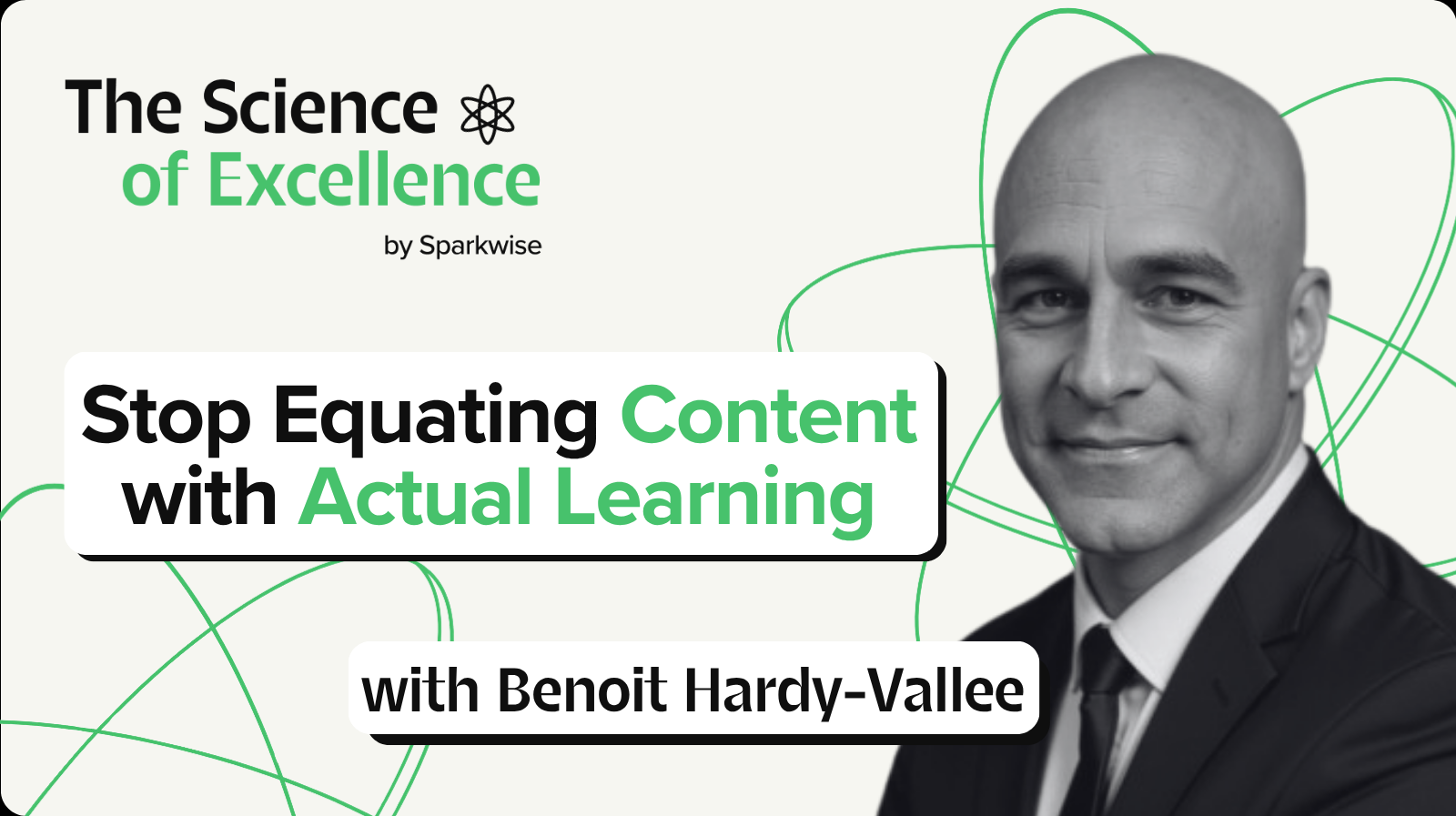

In this episode of The Science of Excellence, I sat down with Benoit Hardy-Vallee, Director of Human Capital at Deloitte Canada. Benoit has spent years helping organizations move beyond content delivery to build real capability.
We talked about why consuming content doesn't develop skills, how to bring back the apprenticeship model in distributed work environments, and why L&D needs to become capability engineers instead of content factories.
These 5 insights stood out:
- Learning Requires Practice and Feedback
- Bring Back the Apprenticeship Model
- Manage Learning Like a Product Portfolio
- Create Learning Ecosystems, Not Just Events
- Turn Your Team Into Capability Engineers
1. Learning Requires Practice and Feedback
In Benoit's Words: "We started to equate consuming content with learning. While this is a way of learning, the fact that I have gigabytes of content available doesn't necessarily help me develop my skills. One of my colleagues was saying you don't learn how to ski just by reading a book about ski. You actually need to do some practice. You need to have some feedback."
Organizations long equated content consumption with skill development but having the information available doesn't mean people can do the work.
Remote work, LMS platforms and digitization made it easy to push content, but clicking next and taking a quiz doesn't build muscle. Organizations that actually grow skills create moments where you coach someone until they earn the right to do it alone because somebody was next to them. Humans learn from each other naturally and effectively.
2. Bring Back the Apprenticeship Model
In Benoit's Words: "Apprenticeship is when you learn with someone through your work. You work side by side. Typically someone has more experience on a topic and the other has less. By questioning, engaging, coaching in the moment, correcting, giving feedback. First you watch how to do an intubation, then one day you do one under very close supervision. Then you do it alone, and then nobody's watching because you're fully entrusted."
Distributed work disrupted traditional apprenticeship. People used to learn by working next to someone competent until they became competent themselves. Traditionally this is how restaurant kitchens work, and how professional services used to operate.
In surveys, people told Deloitte they weren't getting this apprenticeship experience enough in their current day to day. So they formalized it with a pilot cohort and over 90% of participants said it changed their job and helped them be better employees or leaders. With AI automating entry-level tasks, we need to formalize the informal because the kitchen is everywhere and nowhere. We lost the natural learning that happened from working side by side.
3. Manage Learning Like a Product Portfolio
In Benoit's Words: "When I think about a product, it's something that's maintained. You're looking at what's working, what's not working, what are the different features. You have a portfolio of products, certain will be demoted, other will be promoted. It's designing the right product and tailoring it to the client. We review every six months what's working, which one should we put on our pipeline."
Learning programs get built once and forgotten, while products get maintained, refreshed, and managed strategically.
Deloitte calls them Academies (on topics like AI, leadership). Every six months they review what's working and what goes on the pipeline. Just like OpenAI shipping features every two weeks, they maintain the same logic. Each academy has a product manager with a 360 view of design, sales, and delivery. For build-operate-transfer models, they make everything explicit: facilitation standards, content, methods, timing, governance. Without clear governance, it fails.
4. Create Learning Ecosystems, Not Just Events
In Benoit's Words: "What people enjoy most is that instead of cramming everything into two days, we spread it over six to eight weeks so they have a real experience. We don't have to connect the dots for them. Rather than telling them it's important to collaborate across silos, we make them collaborate across silos, and then the magic happens. It's like drip marketing. You change people's behaviors and mindset little by little."
Two-day workshops cram information that disappears immediately, while real behavior change happens through varied experiences over time.
Deloitte spreads learning over multiple weeks: in-person sessions, remote components, small pods and missions with managers. Instead of lecturing about collaboration, they make people collaborate and the magic happens. Get people active and talking, not sitting through slides. The time plus interaction lets them own the ideas instead of feeling fed information.
5. Turn Your Team Into Capability Engineers
In Benoit's Words: "Content creation now, the cost is pretty much zero. The job of the instructional designer is to be what I call a capability engineer. It's figuring out, here's a role, here's the task, the KPI, how can we help that person acquire the information, knowledge, skills they need to accomplish the job? It should make L&D an even stronger orchestrator of learning and less of a doer of learning."
AI has automated key parts of content creation. L&D can't be content factories when anyone can generate curriculum.
Once everyone has AI tools, 80% of the content question is gone. The role becomes capability engineering, which means figuring out how to help people acquire skills to do their job and then creating the minimal effective dose that gives the right developmental experience without disrupting work. L&D becomes an orchestrator of learning, not the doer. Your role is baking developmental experiences into work to achieve business goals.
Until next time,
Vince

.png)
.png)
.png)

.png)
.png)
.png)

.png)
.png)
.png)


.png)


.png)