

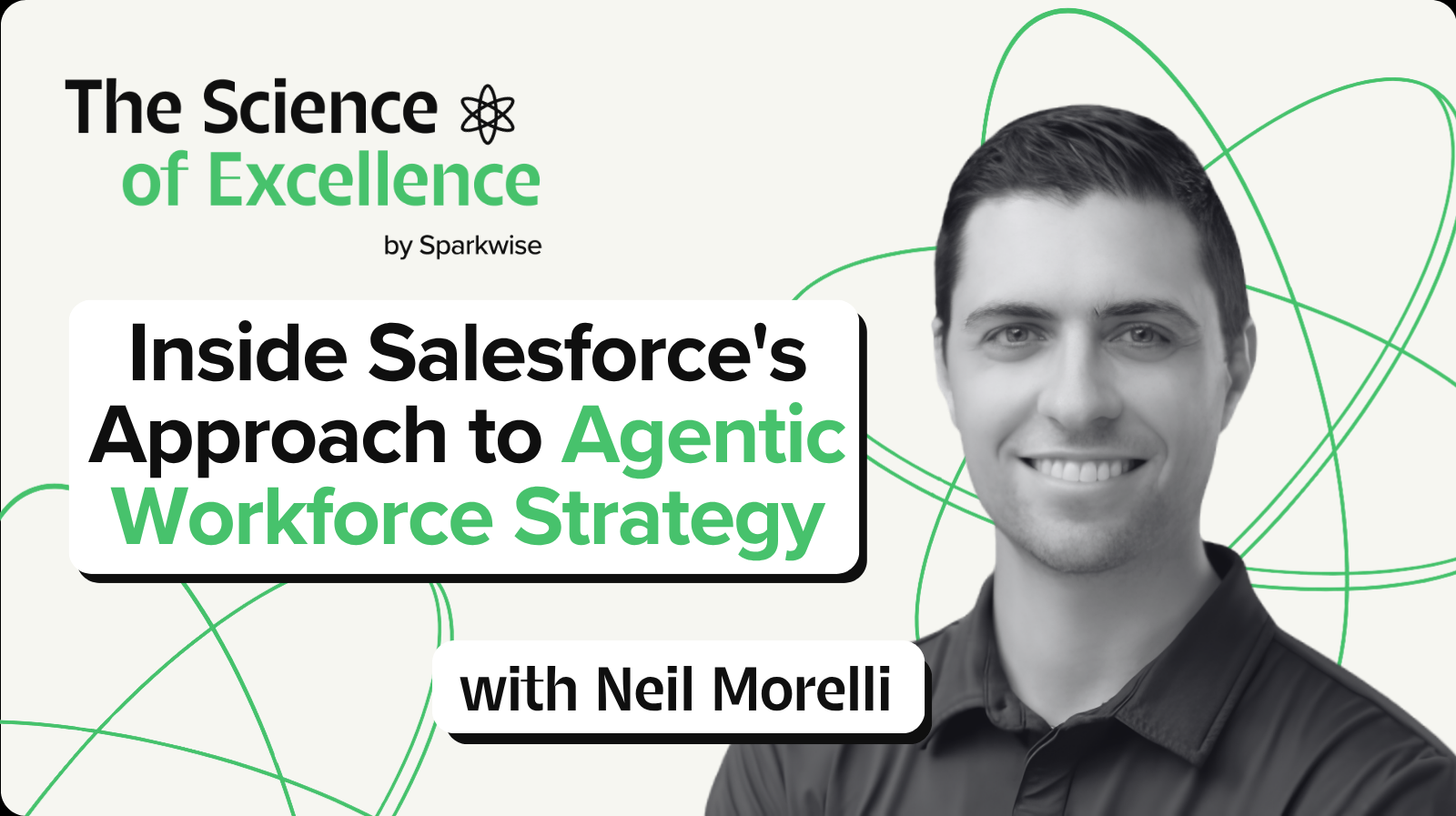

In this episode of The Science of Excellence, I sat down with Neil Morelli, Sr. Director of Workforce Transformation at Salesforce, where he works on their Agentic Workforce Strategy and Innovation team. Neil is an industrial organizational psychologist by training and thinks about AI transformation through the lens of human behavior and organizational readiness.
We talked about why occupational identity is the real barrier to AI adoption, how process consulting beats prescriptive blueprints, and why starting small only works if it's connected to something bigger.
These 5 insights stood out:
- Start Where the Movement Already Is
- Address the FOBO
- Stop Handing People the Blueprint
- Stay in the Drivers Seat
- Start Small with a Big Why
1. Start Where the Movement Already Is
In Neil's Words: "If someone's listening to this and saying, where would I start if I'm interested in pushing transformation forward in my organization, I would say go to where there's already movement and people are overcoming that coefficient of friction. There might even be named transformation leaders that are already thinking this way, and you just don't know what they're up to yet. It is definitely forming partnerships, being patient sometimes, but also helping them envision that future."
Trying to convince resistant leaders is a losing strategy. Go where the energy already exists.
Some teams have already crossed that threshold in their mind. They're building prototypes, showing off cool things with AI and pushing their group forward. Your job is to partner with them and bring enough structure so the success story becomes compelling to other leaders. When one group shows real results, other groups start asking questions. You draft off that inertia instead of trying to create it from scratch.
2. Address the FOBO
In Neil's Words: "If you have a tool that's saying either you need to start completely over or this technology's gonna take your job away, it really threatens that occupational identity. There's this great study that looked at librarians when the internet was first coming to libraries. Librarians that were able to redefine their occupational identity with that technology involved went from being the gatekeeper of information to the tour guide, the person making information come to life for you. That was a really meaningful reorientation."
People's sense of who they are is deeply tied to their job. AI threatens that in ways most organizations aren't talking about.
Neil calls it FOBO - fear of becoming obsolete. It's showing up in the younger generation who've been promised a certain occupational identity that's now under threat before they even start. The way through is helping people reconstitute their identity with AI included. That means enablement that goes beyond knowing which buttons to click. When people have the agency to redesign their own workflow and integrate AI on their terms, they can build a stronger occupational identity than the one they had before.
3. Stop Handing People the Blueprint
In Neil's Words: "I'm a big believer in a process consulting model where the answers are in your clients' heads. They already have the answer. They just need help drawing that out and putting it into a structure where they can start to see the boundaries and the shape of what that future could be. Your job is not to say, here's exactly what's gonna happen, do you agree yes or no. It's walking them through that process."
Leaders who are emotionally ready for AI transformation usually already know what needs to change. They just haven't articulated it yet.
Neil gives leaders the right prompts and questions, sometimes even using AI tools as a thought partner in the room, and lets them sketch their own vision. That ownership matters. A blueprint handed down gets debated, a future people painted themselves gets championed, and for teams already doing things, the job shifts to bringing structure to their experiments, helping them connect what they're building to a business objective, and making sure they're measuring impact in a way that's compelling beyond their team.
4. Stay in the Drivers Seat
In Neil's Words: "Delegating tasks to the AI is actually only a smaller portion of how I use these tools. I find it's more effective when it's acting as a thought partner. I'll give it an objective and have it ask me questions about that task. Then I'll use that conversation to create another prompt in a new session that I build on top of. I tell it, don't write anything for me. I will do the writing. At the end of the day, I can see myself better in that end product."
Neil used to have AI edit his writing inline, going back and forth with highlighted sections. After a few iterations he'd lose the thread of what he was even trying to say.
Now he uses AI to sharpen his thinking before he writes. Give it an idea, let it ask questions, let it help outline, then take over. He refines his approach so well through that process that the actual building feels natural. The reason it works is that Neil can still see himself in the end product. If you can't recognize yourself in the output, you can't intellectually own it.
5. Start Small with a Big Why
In Neil's Words: "You have to start smaller. But the qualification is you do wanna start small while having some kind of business case that is higher level, that is more focused on competitive advantages. You're only ever really gonna build momentum at a smaller scale first rather than trying to train everybody all at once everywhere on this thing. But keep the big picture in mind. Directionally know why, and have a strong why statement."
Starting small is common advice. The part most people miss is that small experiments die without a compelling reason to scale them.
Neil's qualification matters. You need a business case connected to competitive advantage sitting behind those experiments. Without that, pilots become isolated stories that never go anywhere. The why is what turns a proof of concept into organizational change. It also helps when talking to other leaders who need to see how a small win connects to something bigger before they'll invest their own team's time.
Until next time,
Vince

.png)
.png)
.png)

.png)
.png)
.png)

.png)
.png)
.png)


.png)


.png)