

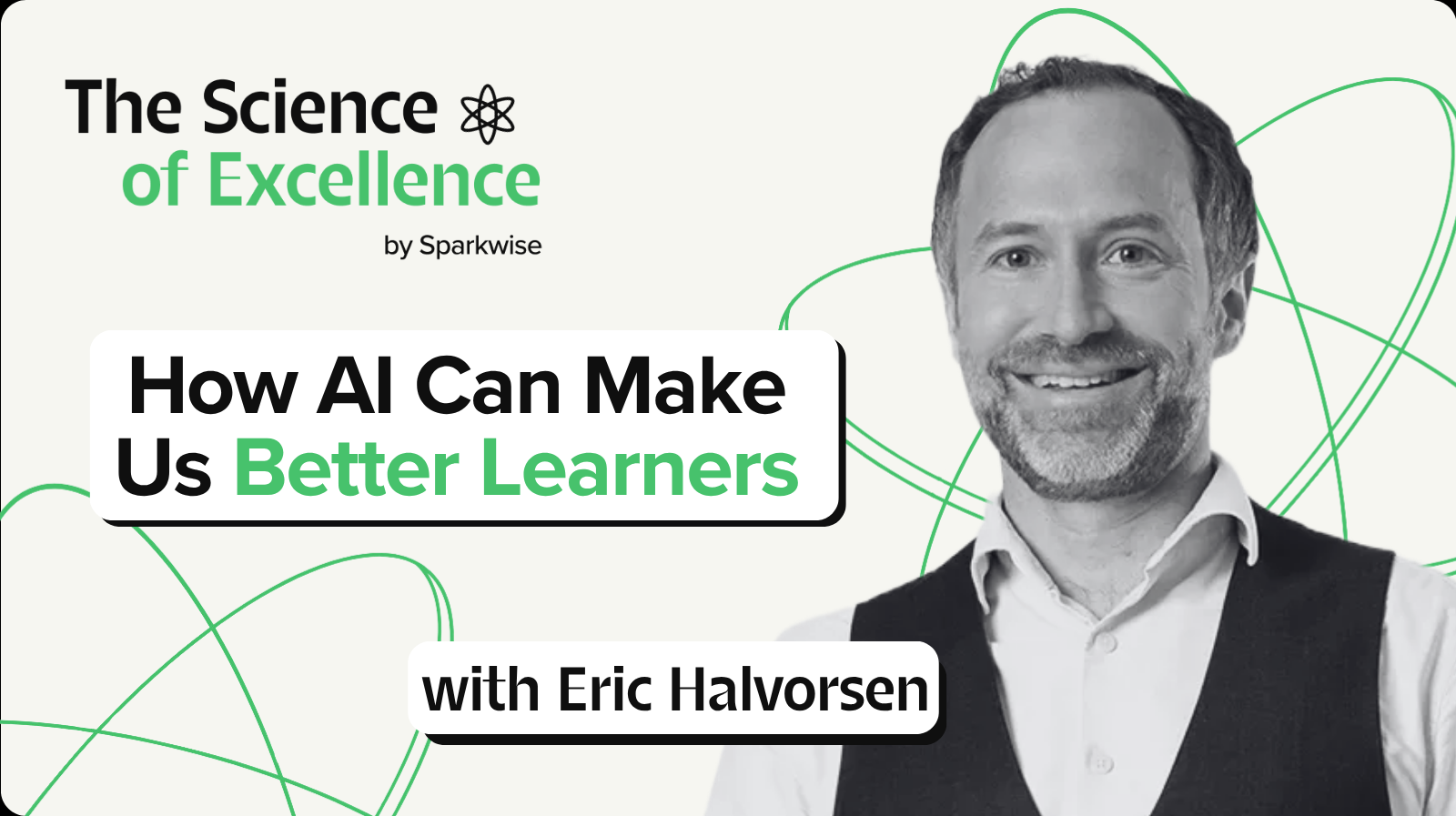

In this episode of The Science of Excellence, I sat down with Eric Halvorsen, Global Director of Leadership & DDAI Academies at Danone and Host of The Learning Edge Podcast. Eric's background is in language education and second language acquisition, and he's spent years thinking about what makes people effective learners.
We talked about AI's potential as a super learning coach, the risks of over-personalization, and why building a healthy learning ecosystem goes far beyond a course catalog.
These 5 insights stood out:
- Turn AI Into a Learning Strategist
- Watch Out for the Personalization Echo Chamber
- Invest in Social Learning Experiences
- Help People Find Their Why First
- Give People the Opportunity to Fish
1. Turn AI Into a Learning Strategist
In Eric's words: "AI has the power to become a super learning coach. If you are in the gym, your personal trainer is gonna say, lay off the bicep curls you've been doing again and again. Do some cross-training. The best learners deploy a breadth and diversity of learning strategies. AI can help you build a learning plan, keep you honest, nudge you. The potential is immense."
Most people think of AI as a sparring partner for practice, while Eric sees it as a learning strategist.
Research on language learning shows that the best learners use a wide range of strategies, both direct (memorizing, analyzing, practicing) and indirect (planning the learning process, emotional regulation, staying motivated). AI can coach people across all of these. Eric tried this himself learning Japanese. He asked AI to build him a diverse learning plan for a trip two months away and it worked. The OECD's 2026 Digital Education Outlook found that AI tutoring can double learning effectiveness, but only when it's built to scaffold the process. If AI just gives you the answer, you can succeed at the task and fail at learning.
2. Watch Out for the Personalization Echo Chamber
In Eric's words: "I met a provider at Learning Technologies France that showed me a tool where the learner can say, give me that same e-learning but I want it as a podcast. Bang, podcast. I want it as a video. Bang, video. What happens is it creates an echo chamber of your favorite learning strategy again and again. You've got the over-bicep-curl effect at scale. You're not pushing people out of their comfort zone."
Letting learners choose their preferred format every time sounds great, but in practice it reinforces the strategies they're already comfortable with.
The same thing happened with microlearning during the period when everything had to be microlearning or your program was terrible, which proved to be false as often people need to sit and think for long periods. Personalization has the same risk of becoming the only answer. Yes, AI tutoring at scale is incredible for students who've never had access to personalized support, but if the only thing you're doing is catering to people's comfort zone, you're limiting their growth.
3. Invest in Social Learning Experiences
In Eric's words: "After COVID, people wanted to do the programs that everybody else was doing. I might find the program that's really most fit for them, but often they're like, yeah, but I've heard about this other program that everyone on my team is doing. I wanna do that one. And why? Because they wanna be part of a group. Some of the most powerful transformations we've been on have been one-size-fits-all programs because everybody's on the same page."
We're social animals. People want to learn together even when a more personalized option exists.
The way Netflix shows personalized recommendations while displaying what’s trending applies to learning as well. Collective experiences create organizational glue that personalized paths can't replicate. People want the ability to reference what they went through together. Replacing collective learning with personalization is not the answer.
4. Help People Find Their Why First
In Eric's words: "My former CLO Thierry Bonnetto had this motto: intention multiplied by skills equals performance. It starts with intention. If people know why they're doing something, they'll find the skills to do it. Yet if people have the skills and no intention, even if they're great at it, it doesn't work. You can crush motivation much more easily than it is to build it up in an organization."
The motivation problem in learning will always exist, the same way it exists in fitness. No amount of technology changes that for people who aren't interested.
What good organizations do is help people find what makes them tick and provide career paths that let them express those talents. When someone has a spark of motivation, that's the moment to help them build good habits. Meet them with the right resources, suggest a learning plan, pair them with a buddy, and help them see progress. People who get learning wins are much more likely to keep going than people who finish an e-learning and don't know what to do next.
5. Give People the Opportunity to Fish
In Eric's words: "A good learning organization gives people the fish, teaches people to fish, and gives people the opportunity to fish. If somebody's upskilling on something and you never let them try it and fail and do it on their own, in terms of motivation, it's a killer. They're gonna stick to what they know. You also need to nurture the ecosystem. Psychological safety, the right to test and learn, the right to fail, listening, empathy, trust. You can't just work on the course catalog and hope."
Most organizations give people content and teach skills, then stop. The missing piece is giving people room to actually try, fail, and apply what they've learned.
That means gigs, internal missions, internal mobility, learning projects as part of development plans. But even that isn't enough if the ecosystem is unhealthy. Psychological safety, trust, and the right to fail are what make the environment work. Without them, people won't take risks no matter how many opportunities you create. AI can help here too. It can surface biases in meetings, flag when voices aren't being heard, and run postmortems on projects so teams learn collectively. But the foundation is human. If people feel that technology is degrading trust rather than growing it, AI becomes a problem in the organization.
Until next time,
Vince

.png)
.png)
.png)

.png)
.png)
.png)

.png)
.png)
.png)


.png)


.png)