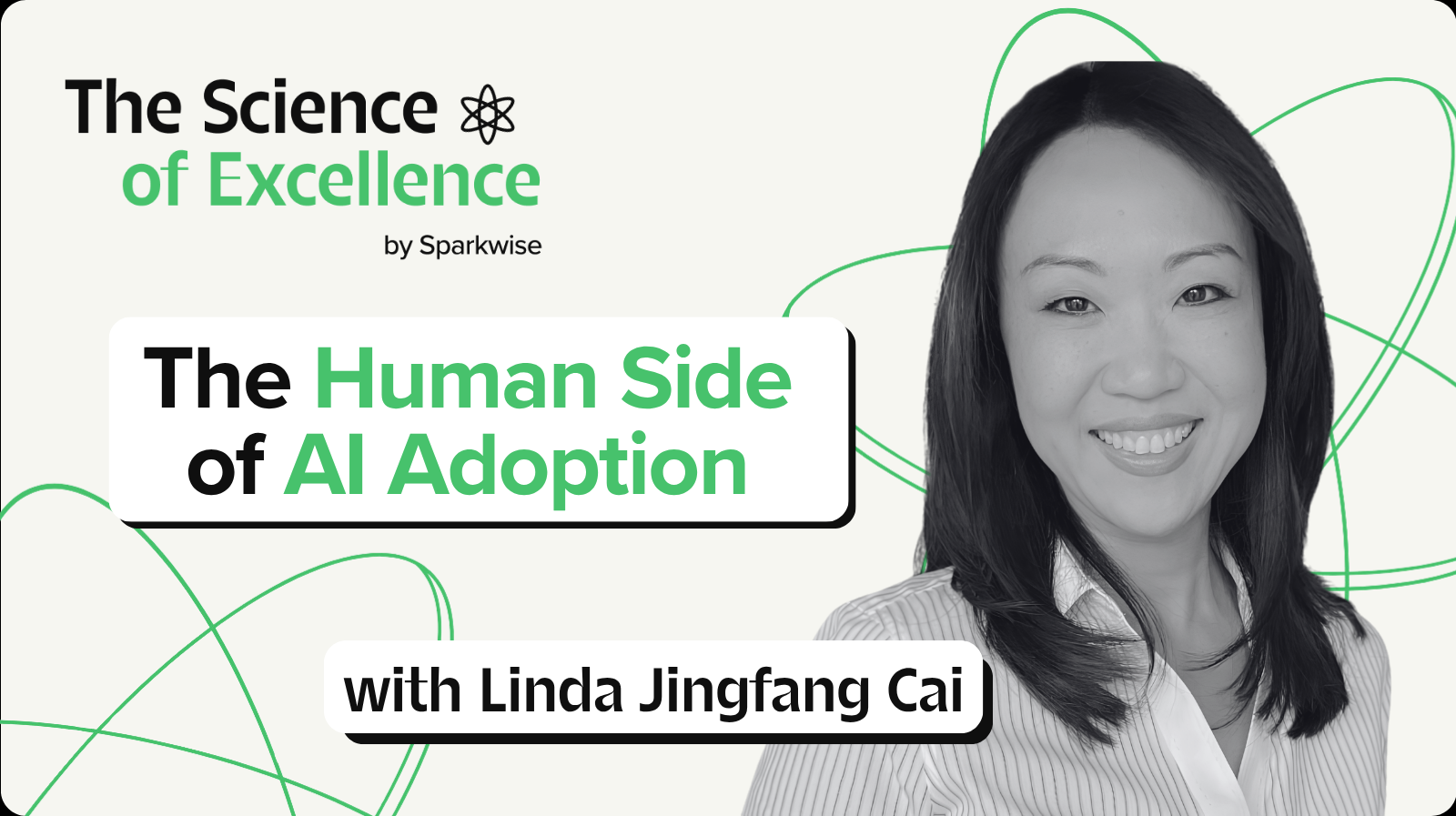

In this episode of The Science of Excellence, I sat down with Linda Jingfang Cai, VP of Talent Management and Culture at R1. Linda has spent over 20 years in talent and change management across organizations such as LinkedIn, Aon and Diageo, and is the author of Share: How Organizations Can Thrive in an Age of Networked Knowledge, Power and Relationships.
We talked about why AI adoption demands a different kind of change management, how persona-based rollouts help leaders find their role, and why upskilling should come before workflow redesign.
These 5 insights stood out:
- AI Is Different Because It’s Probablistic
- Give Leaders a Role They Can Play
- Design for Intellectual Ownership by Humans
- Build Judgment Socially
- Upskill Before You Redesign
1. AI Is Different Because It’s Probablistic
In Linda’s Words: “I hear many people, including leaders, say, ‘AI is just another technology. We’ve done digital transformation for decades.’ I think there’s one fundamental difference between AI and a SaaS tool: it’s less deterministic. As humans who are ultimately responsible for the business outcome, we are not as sure what the outcome is. It touches on this fear of losing control and still having to be responsible at the end.”
Every technology rollout triggers resistance, but AI triggers something more as people can’t predict what it will do next.
Traditional software is deterministic, meaning you click a button and get the same result. AI is probabilistic, which means people are asked to trust a tool while remaining responsible for its output. At R1, Linda’s team sees this with healthcare clients whose executives built expertise over decades of monitoring every step of a workflow. AI changes that to where they’re only evaluating end results, demanding a different mindset regarding when to trust the output and when to override it.
2. Give Leaders a Role They Can Play
In Linda’s Words: “Our leaders think that unless they can use AI as a pro, they don’t feel comfortable letting the team use it to the fullest. Very early on, we crafted five different personas. At the basic level, there’s the AI consumer that will probably never build an agent but will significantly increase their proficiency. And then all the way to AI sponsor. We told them, ‘It’s probably not realistic for you to be in Copilot building agents every day, but these are the things we want you to understand.’”
Executives were stalling on AI because they felt they had to master it before letting their teams use it.
Linda’s team created five personas ranging from AI consumer to AI sponsor. Consumers will never build agents but can still increase their proficiency, while sponsors don’t need to be in Copilot every day but do need to understand the language well enough to prioritize use cases and set ROI expectations. For long-time leaders who couldn’t find time to learn, R1 paired them with hands-on AI coaches who got into their daily workflow and showed them how Copilot could simplify their day. Once they saw it in action, they were on board.
3. Design for Intellectual Ownership by Humans
In Linda’s Words: “AI is creating such a long list for humans to go through that it’s harder to keep up. It’s so easy to not push back and not scrutinize AI output. 75% of people after a while just stop pushing back. We are not only thinking about what’s possible, but making sure that it is done in a way that’s intentional, sustainable, and taking into consideration human psychology into the design.”
AI was supposed to save people time, but so far it’s moved the bottleneck and created more judgment work.
R1 is seeing AI generate longer queues of decisions for humans to work through. Research from Northwestern found that 75% of people eventually stop scrutinizing AI output altogether. Linda’s team designs workflows with this in mind, building in sustainability alongside efficiency. The question now is whether humans can sustain the cognitive load that comes with reviewing everything AI produces and intellectually own the work
4. Build Judgment Socially
In Linda’s Words: “Humans don’t learn from reading tons of data. We learn best through conversation. We put people onto real projects and they shadow another person. We do simulation, peer conversation, coaching each other. That builds confidence. We are social animals, and that’s the best way people feel like they’ve had a good experience.”
AI can process data, while humans build judgment by talking through problems with other humans.
Junior development relies heavily on shadowing, peer conversation and simulated case studies. Linda’s team finds people who are natural critical thinkers and puts them into learning sessions to role model the behavior. These tend to be people who had nonlinear career paths, are comfortable not knowing the answer, and ask questions that help others think differently. The social aspect builds confidence and creates relationships people can lean on when they face real decisions.
5. Upskill Before You Redesign
In Linda’s Words: “Put upskilling ahead of redesigning the roles and the workflows. I still believe that human nature is continuous improvement. We wouldn’t have been here if we didn’t have the gene to always want to do better. But it matters if we feel equipped to do that. Otherwise, we go into a dark place and it’s not good for anybody.”
Most companies rush to redesign workflows before their people are ready to work in them.
Linda’s advice is to invest in upskilling first. People need to feel equipped before they can navigate change, and without that foundation they lose confidence and tend to disengage. A lot of workflow reinvention requires people to act with agency and imagination, which is hard to come by when they feel unprepared. Building capability first makes workflow change possible.
Until next time,
Vince