

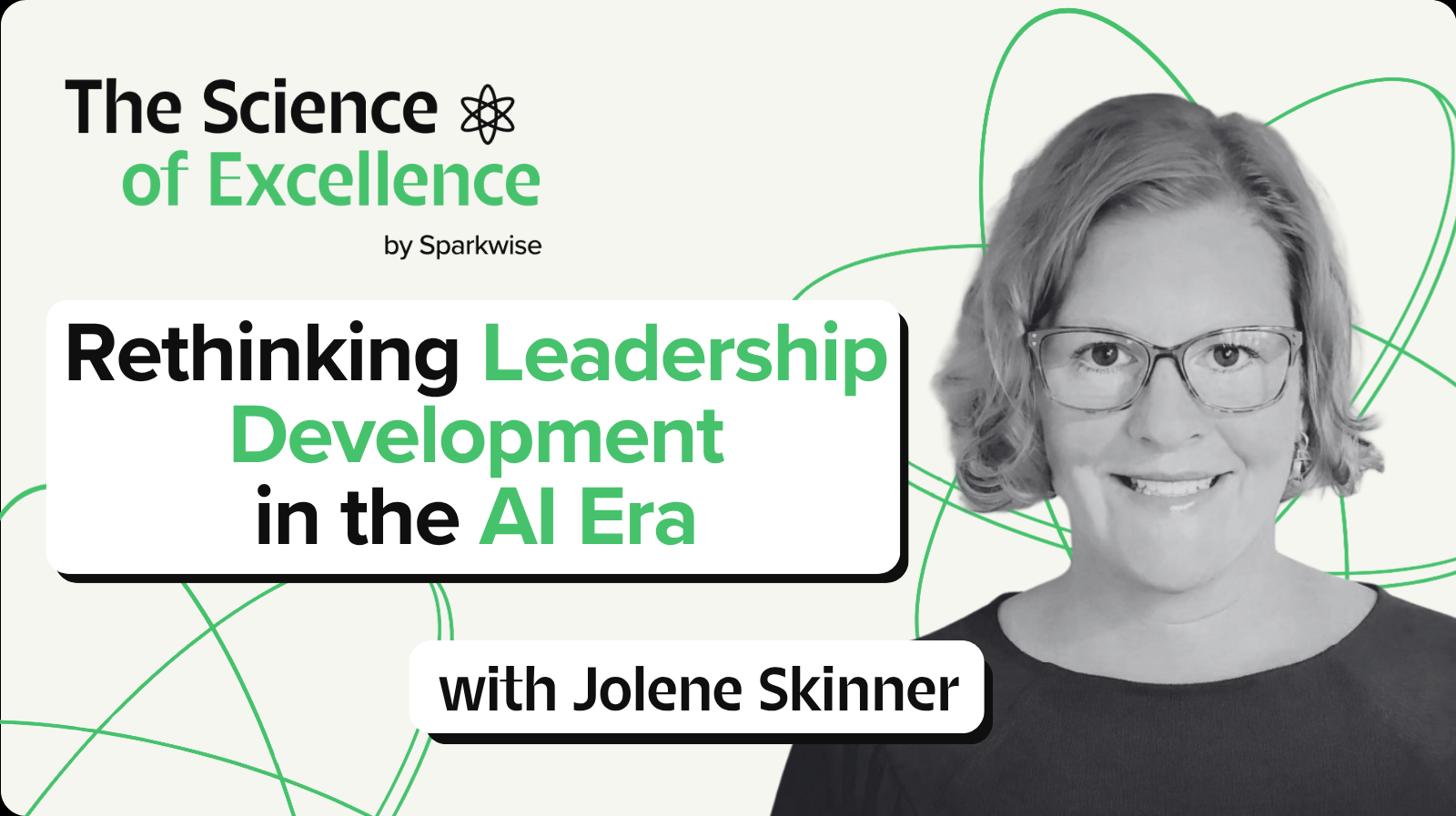

In this episode of The Science of Excellence, I sat down with Jolene Skinner, VP, Head of Culture, Talent and Development at MongoDB. Jolene is an organizational psychologist by training and has spent her career thinking about how to scale leadership in ways that truly transfer back to the day job.
We talked about why traditional leadership training struggles to stick, how AI can reduce bias in feedback, and why culture should be architected with the same rigor as product.
These 5 insights stood out:
- Build AI Into the Full Manager Support System
- Model the Experimentation You Want to See
- Let AI Surface the Blind Spots
- Let the Data Make the Case
- Thread Culture Into Everything You Do
1. Build AI Into the Full Manager Support System
In Jolene’s Words: “Managers want help. Managers need help. If an AI coach is there to help by offering advice, options, suggestions, questions, the manager’s more likely to engage. I don’t like to be pure to model. I want all of it. I want the coaching, I want the mentoring, I want the advice. I want the ‘This is actually an escalation, and we’re gonna stop right now, and you need to contact this person because what you’re saying to me is something that a human must engage in immediately.’”
Most AI coaching tools try to do one thing. Jolene wants them to do everything a good HR business partner would.
Her team at MongoDB is building AI skills that mentor, advise, escalate and coach depending on what the manager needs in that moment. If a situation requires a human, the tool flags it. If a manager needs help integrating feedback into a clear summary, it handles that fast. Managers will come back when the tool solves real problems instead of asking open-ended questions while they’re trying to get through their day.
2. Model the Experimentation You Want to See
In Jolene's Words: "Sometimes coaching gets put into this precious box of being pure to the process, which by definition is an inquiry-based process where you ask a lot of questions and help learners get to the answer on their own. Managers have no time for that. Managers want help. Managers need help. If an AI coach is there to help by offering advice, options, suggestions, questions, the manager's more likely to engage."
Pure coaching methodology sounds great in theory, but in practice, busy managers need direct help solving real problems.
Jolene's team is building skills that help managers get work done faster on the problem statements they regularly face, such as integrating all the feedback they’ve collected on an employee into a clear summary. That's the kind of help managers come back for. Coaching is one way to help, but so is mentoring and knowing when something is an escalation that needs a human immediately. The goal remains making managers better managers.
3. Let AI Surface the Blind Spots
In Jolene's Words: "Managers are terribly biased. They have their favorites. They remember what you did last week. They pay attention to things they inspect more, and they forget about things that happened before. In this case, I actually think AI could have very good judgment if it's been well-trained and well-prompted. The tone of the feedback was so objective, I didn't find myself being defensive at all."
Everyone worries about AI bias. Jolene's point is that human managers are already deeply biased, and in some cases AI does better.
She tested this herself by running her own mid-year review through AI, giving it access to her transcripts. The AI surfaced a blind spot she'd never received feedback on from any human, and because the tone was objective, she didn't get defensive. She ran the same experiment for her team and the themes matched what she already knew, but the language varied depending on how the prompt was set up. Her team member who owns performance management immediately started planning how to roll this out for all employees at year-end.
4. Let the Data Make the Case
In Jolene’s Words: “Recently trained managers were sometimes beating the engagement scores for employees who got lower performance ratings than untrained managers were getting for employees with higher ratings. We shared it with our executive team, and they just stared at this slide for a long time, and they said, ‘Shouldn’t we just require training for everybody?’”
MongoDB didn’t make manager training mandatory by arguing it mattered. They let one slide do it for them.
After recalibrating performance ratings so fewer people landed in the top bucket, Jolene’s team ran the engagement survey and sliced the results by training status and rating. Trained managers who delivered disappointing ratings still scored higher on engagement than untrained managers who delivered good ones. The trained managers handled the hard conversation better than the untrained managers handled the easy one. When the executive team saw that comparison, they required training for every manager with escalation if not completed within six months.
5. Thread Culture Into Everything You Do
In Jolene’s Words: “It can’t just be about training. It has to be about your cultural framework. We have clear values, clear leadership principles, and they are embedded in everything we do. If you do a performance review, if you get an employee survey, if you are doing a workshop with your team, these things are threaded through everything. It becomes the language of the business. You can architect culture or you can accidentally just let it happen.”
Most organizations let culture evolve by accident. Jolene treats it as something you architect with the same rigor as product.
MongoDB threads its values and leadership principles through performance reviews, surveys, workshops and team meetings so it becomes the language of the business. They chose one core framework for feedback instead of offering ten, because a common language is what actually transfers. Their new CEO reinforces this with a visible focus on customers and a belief that leaders must be optimistic. Jolene’s job is to make what’s happening in the culture visible, document it and reflect it back to leadership so nothing drifts.
Until next time,
Vince

.png)
.png)
.png)

.png)
.png)
.png)

.png)
.png)
.png)


.png)


.png)